Know which session needs you.
A native Mac terminal manager that keeps projects, sessions, and attention organized.
Run shells, dev servers, tests, and coding agents across several projects while Saggar tracks what is working, waiting, finished, and failed. Sessions that need a decision stay visible without pulling you away from the session you are using. Pair the Saggar phone app to check in and respond while you are away.
Mac only. Requires macOS 26 Tahoe or later on Apple silicon.
No account needed.
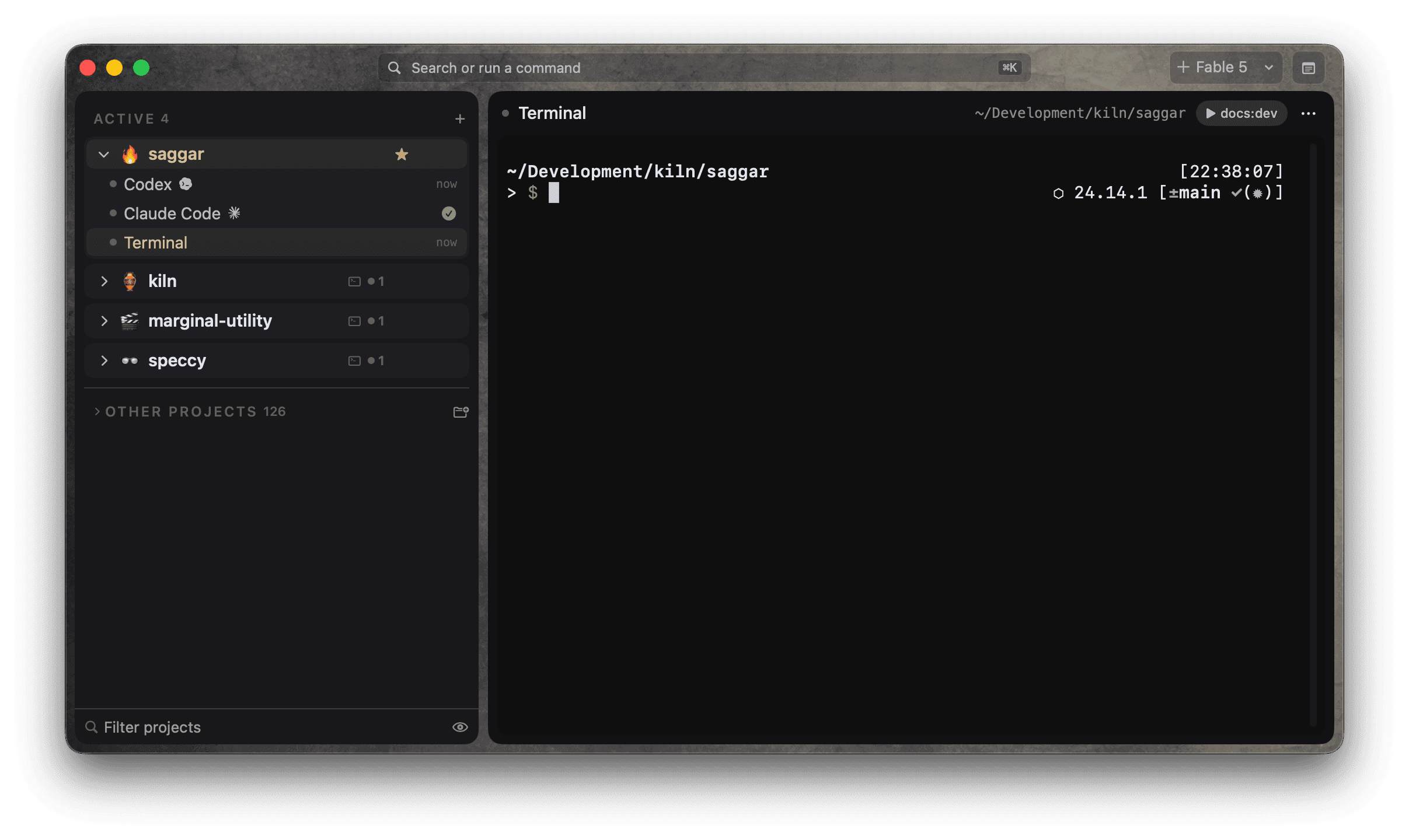
Keep several agents moving
One agent is editing, another is running tests, and a third is waiting at a permission prompt. A fourth finished ten minutes ago. Ordinary terminals show four tabs, but not which one needs you.
Saggar keeps each status visible, moves active work out of the way, and collects sessions that need a decision into one queue.
Why we built it this way — what we think agents are good for, why that makes the developer more important rather than less, and what supervising six of them actually feels like.
The intro
The supervision loop
Start work across projects
Run agents, shells, dev servers, and tests across every codebase. Each session stays attached to its project, branch, and worktree.
Leave working agents alone
Sessions classify themselves as needs you, working, idle, finished, or failed. Working sessions stay out of the way. Prompts, failures, and finished work remain visible.
Handle what needs you
Waiting prompts and finished work form one ordered queue. Answer from the attention card, or press ⌘J to move through it by priority.
Step away without losing the thread
Pair the Saggar phone app to see what your sessions are doing while you are out. Inspect a session, answer its prompt, interrupt a runaway, or type into it.
Keep the work moving
Knowing what needs you is the start. Saggar also helps you give direction, inspect the details, and keep your place as work grows.
Show the agent what you mean
Add numbered comments to an image, or attach files to the initial task so the agent starts with the context you have in mind. Add image annotations · Attach files
See what you're working with
Preview files and image placeholders in terminal output, then follow a file path straight into your editor. Preview files · Preview sent images
Act when the thought occurs
Queue the next prompt while an agent is busy, use a quick run for a command, or open the command palette to act on an idea. Queue a prompt · Explore the command palette
Keep your place as work grows
Organize sessions by project, keep monitors nearby, and check session previews and attention cards without losing your place. Restoration brings your workspace back after a restart. Organize your workspace
Stay involved away from the desk
Pair the Saggar phone app to inspect sessions and respond, with the access you approve on your Mac. Keep your Mac awake, online, and running Saggar while you work remotely. Set up remote access
Make it feel like your Mac
Choose from vibrant or neutral themes and leave your mark.


Use Saggar away from your Mac
- Sign in on both devices. Use the same Marginal Utility account on your Mac and phone. Saggar verifies the account during pairing and on every request.
- Scan the QR code. Find it under Saggar → Settings → Remote control. Scanning enters the Mac identifier and pairing code for you. After the account check, the Mac asks you to approve the device.
- Pair once. Pairing doesn't expire through inactivity. You can revoke one device, or sign out on the Mac to revoke them all.
Secure by default
Remote control is ready when you need it, but only devices signed into your Marginal Utility account can pair. The Mac checks the account again on every request.
A device pairs only while it is signed into your account. The Mac checks every request.
The Mac dials out to the relay. It opens no port on your network.
One scan, and it holds. Signing the Mac out revokes every device at once.
The Mac connects to Saggar's relay, so it doesn't open a port on your network.
Documentation
Start with the setup guide, learn the common workflows, or look up a command when you need it.