Projects and sessions
One window, a menu of codebases down the left, and every session nested under the project it belongs to. The arrangement matters: a tab bar makes twenty shells look alike, and the point here is that they don't.
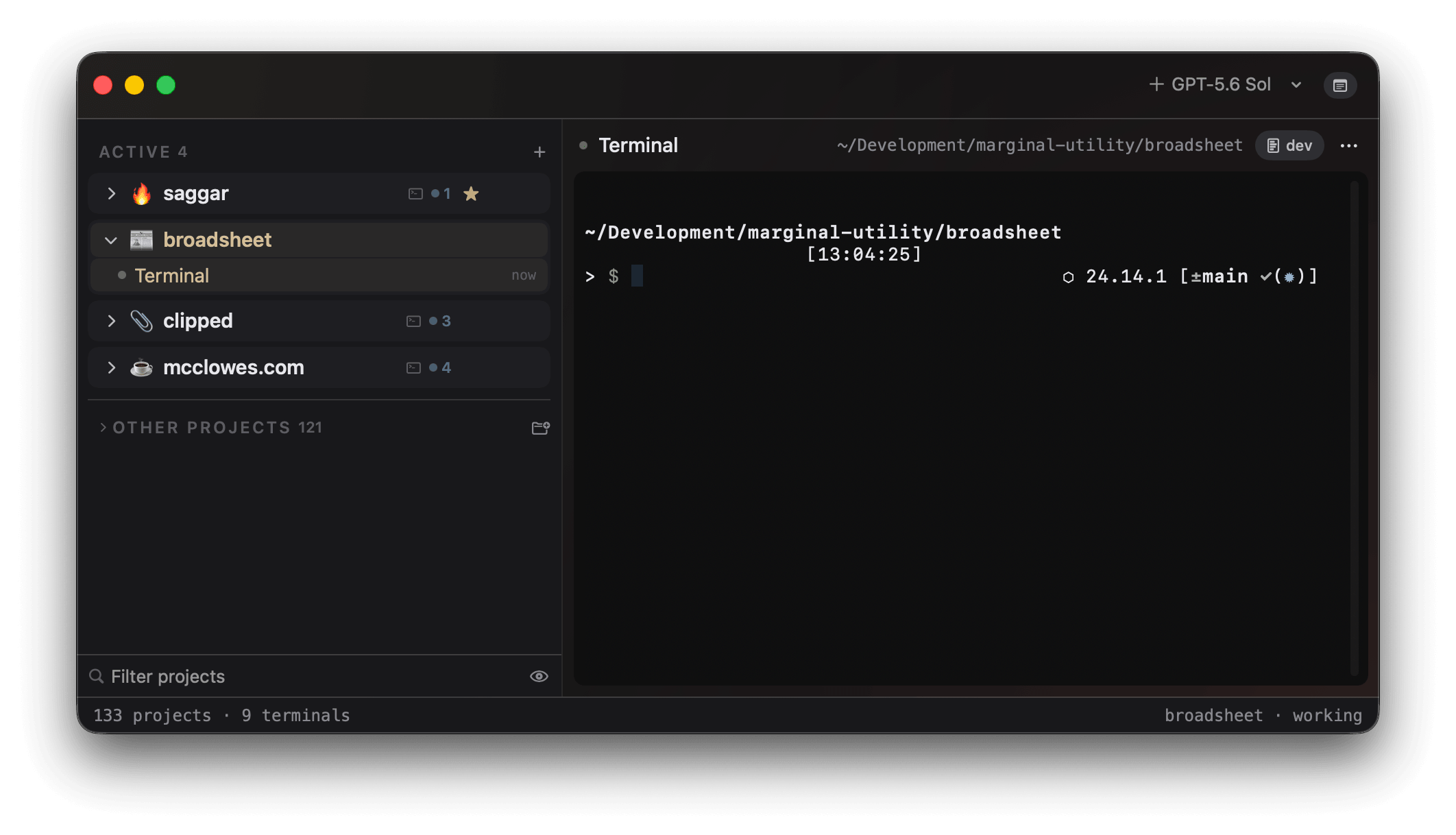
The project menu
Projects with live sessions sit at the top, favorites first and then alphabetically, so a project keeps its place. The rest wait under Other projects.
Each project wears a status rollup dot showing its neediest session's face, so an amber dot four projects down is a real claim on you without anything being unfolded. The project you're in trades that dot for a fold chevron and a quietly lifted card with its sessions inside, where each session's own dot says more than a rollup can.
Add a project
| Action | How |
|---|---|
| Add a codebase | ⌘⇧O |
| Add or focus the enclosing repository from any terminal | saggar ., once you've installed the command (Settings ▸ CLI) |
| Filter the menu | ⌘L |
saggar . climbs to the enclosing git root, so running it from src/ means
the repository. A worktree checkout counts as a project in its own right. The
menu starts empty and offers to set up repo scanning or add a project directly.
The project header
A project's header carries its branch, its dirty and ahead/behind counters, and the buttons to open it in your editor or reveal it in Finder.
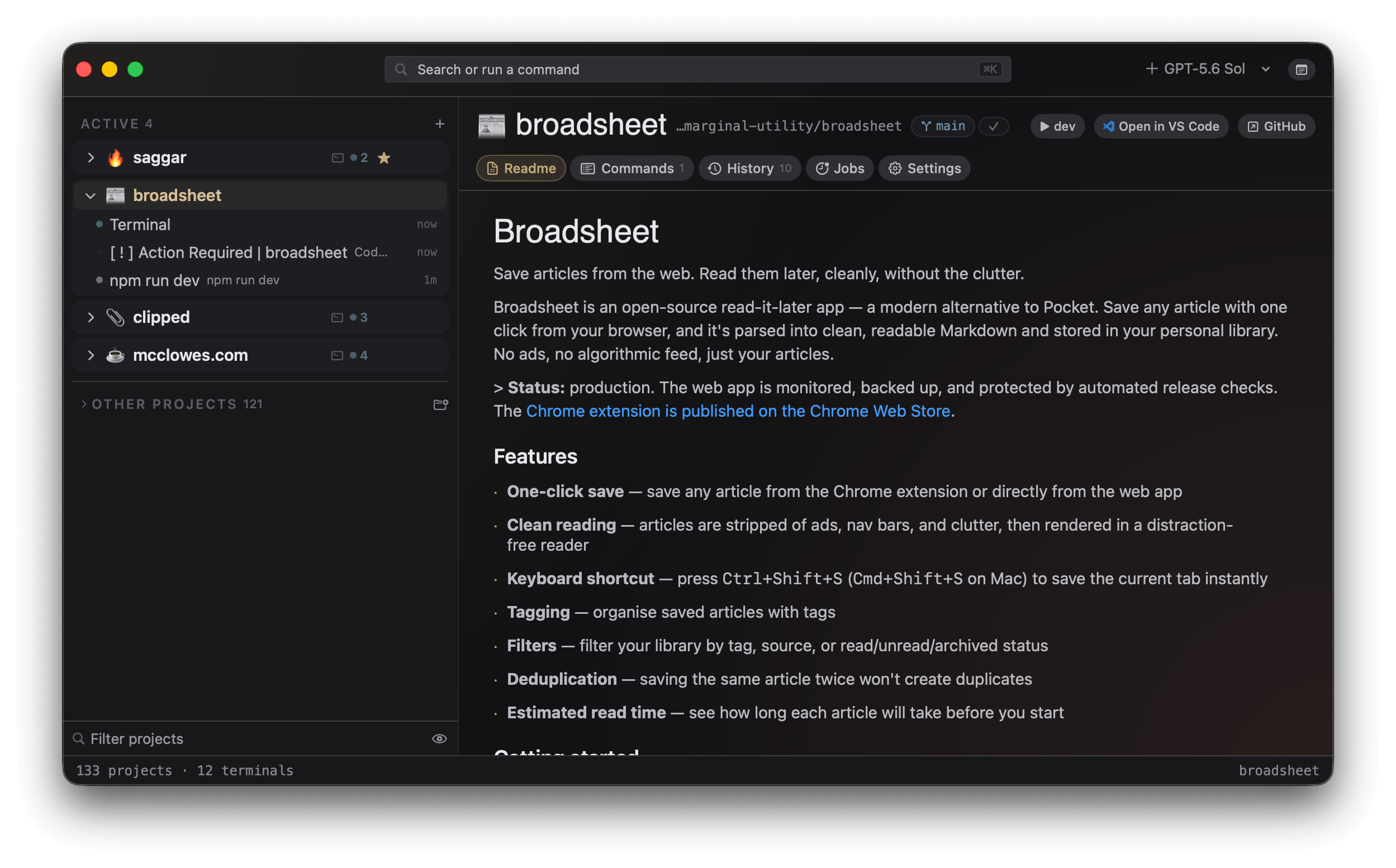
The project landing also has Docs and Agent context tabs for the repository's Markdown, agent instructions, and skills. Worktree cleanup, Git actions, and listening-port ownership live alongside them. See Project workspace for those tools.
Sessions
| Action | Shortcut |
|---|---|
| New session of the type you last picked from the + menu | ⌘T |
| New plain shell | ⌘N |
| Close the session | ⌘W |
Every session is a login shell
Nothing is emulated and nothing is wrapped: it is your shell, your profile, your prompt, with three facts added to the environment so tools can tell where they are running:
SAGGAR=1TERM_PROGRAM=saggar- a per-session
SAGGAR_SESSIONid
Sessions stay alive
Sessions stay alive while you look elsewhere. That is the difference between a manager and a switcher, and it is what makes a background agent's prompt something Saggar can notice.
Placement survives relaunch too: quit with eight sessions across three projects and they return in the same working directories. Plain shells start fresh; supported agents with an installed handshake resume their exact conversations. See Agents for what each provider reports.
Closed sessions
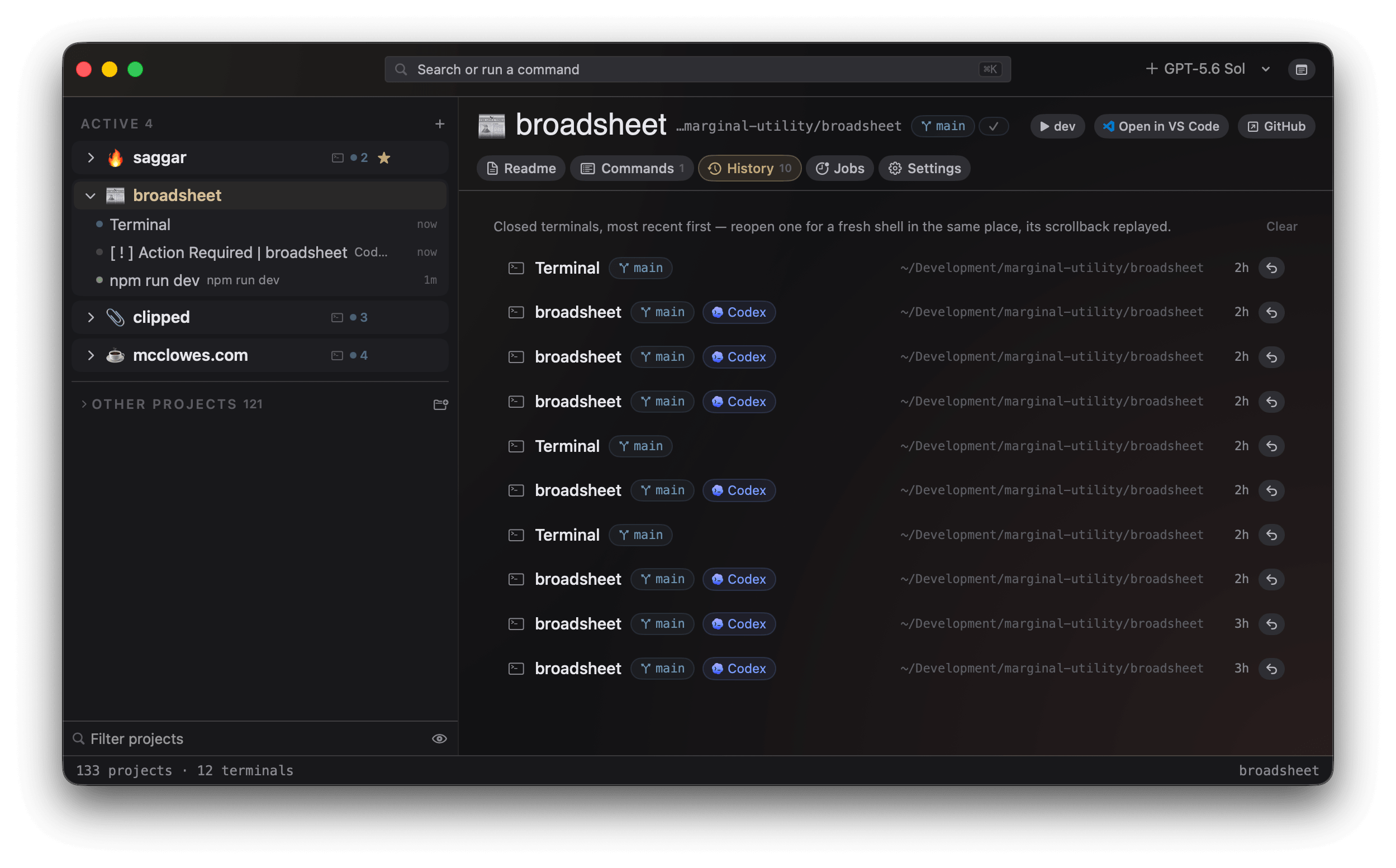
A closed session is remembered by name for a while, so the palette can reopen it with how long ago it went. The common case after a close is wanting it back.
Quick runs
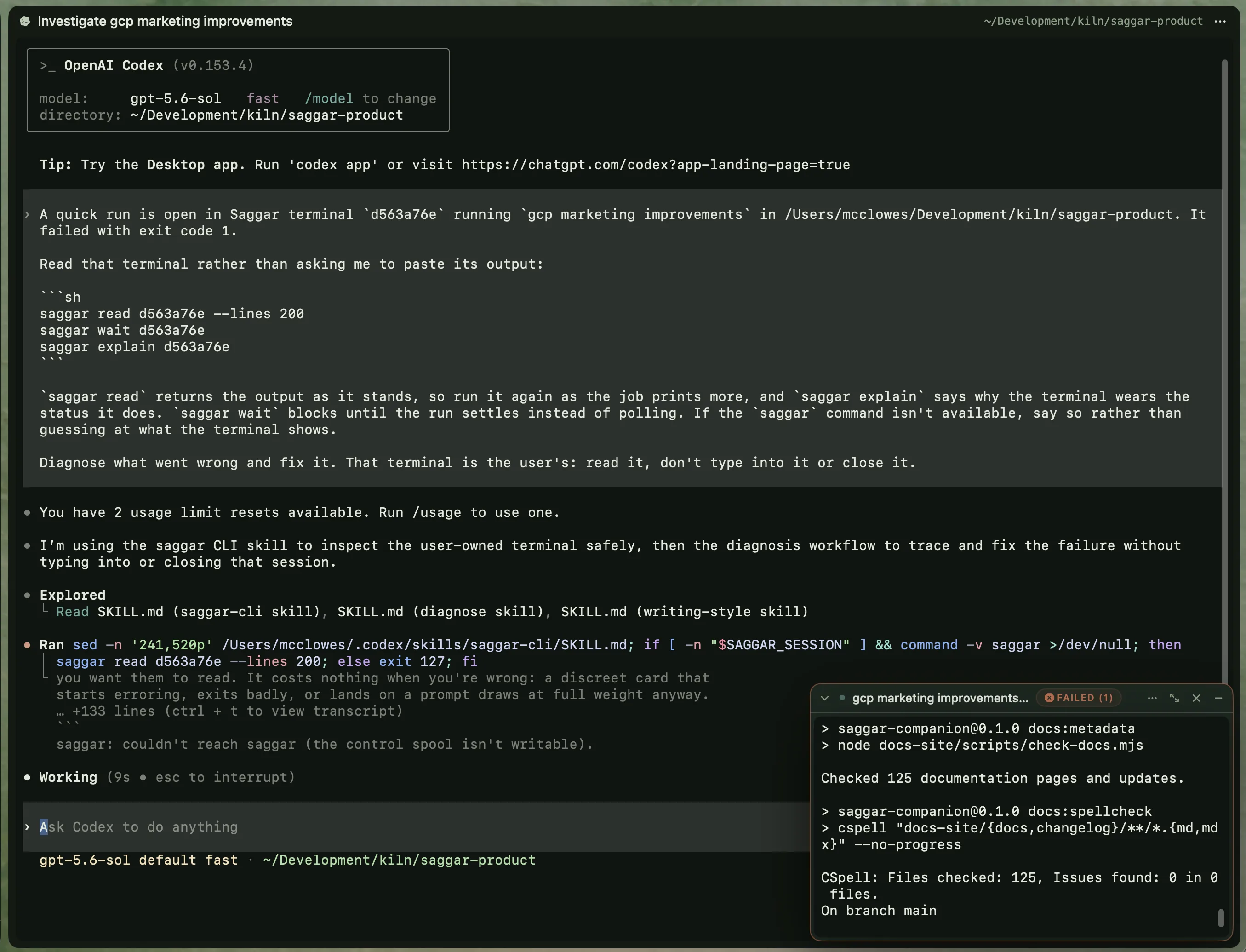
⌘P runs a command without displacing the session you're working in. Its
terminal opens in a compact corner, stays readable while the command runs, and
closes when a successful run settles. A failed run stays open with its exit
code and an amber frame.
Investigate a failed run
Choose Investigate with an agent from the failed run's menu to open an agent in the same project. Saggar hands over the run's terminal id rather than pasting a frozen transcript, so the agent can read the output as it stands and follow a job that is still printing.
The same menu item sits on every terminal: a docked monitor, a split pane, a popped-out window, or an ordinary session. Investigate and fix a bug covers what the agent is handed.
Unassigned sessions
A session tied to no project at all opens at home: the scratch shell you want before you know which codebase the answer is in.
| Action | Shortcut |
|---|---|
| New unassigned session | ⌘⇧T |
| New unassigned plain shell | ⌘⇧N |
The moment it cds into a codebase already on the menu, that project adopts
it. The session reorganizes under the project in the nav, and from there it is
an ordinary project session: branch chip, history, scratchpad and all.
Smart collapsing
A menu that only grows is a menu you stop reading, so it tidies itself. Once every session in a project has gone fifteen minutes without output or input, the project folds its session list away and wears a status tally instead: a dot and a count per status, loudest first, so "one needs you, two working" reads off a folded row without unfolding it.
The threshold is a picker in Settings ▸ Projects, and the whole behavior switches off there.
What never folds
What it refuses to fold is as much of the rule as what it folds:
- A project with a waiting prompt or a live command stays open however old its last byte is.
- The project you're currently in stays open.
- A fold Saggar placed unfolds itself the moment that project wakes or starts needing you.
- Unfold one by hand and it stays as you left it. The chevron is a decision, and the sweep never argues with it.
Reaching for a folded project opens it on the spot, whether by a click, an open from the palette, a new session, or a jump to one of its sessions. Asking for a project is asking to see it.
More than one at once
The menu answers watch many. Three other arrangements answer the cases it can't:
| Arrangement | Shortcut | For |
|---|---|---|
| Split view | ⌘D | Drive a pair: an agent and its dev-server logs, or a scratch shell for git status while a build churns |
| Monitor dock | ⌘⇧M | The long-running watch you keep half an eye on: npm run dev, test --watch, tail -f |
| A window of its own | Header ellipsis | Compare two sessions rather than pair them |
Split view
⌘D splits a fresh shell in the same directory; a menu row's Open beside
current puts an existing session there. One pane owns the keyboard, drawn as
a focus ring and moved with ⌘]. ⌘⇧W collapses the split, returning the
second session to the menu alive.
It is deliberately flat: one extra pane, one axis, no recursive pane tree.
Monitor dock
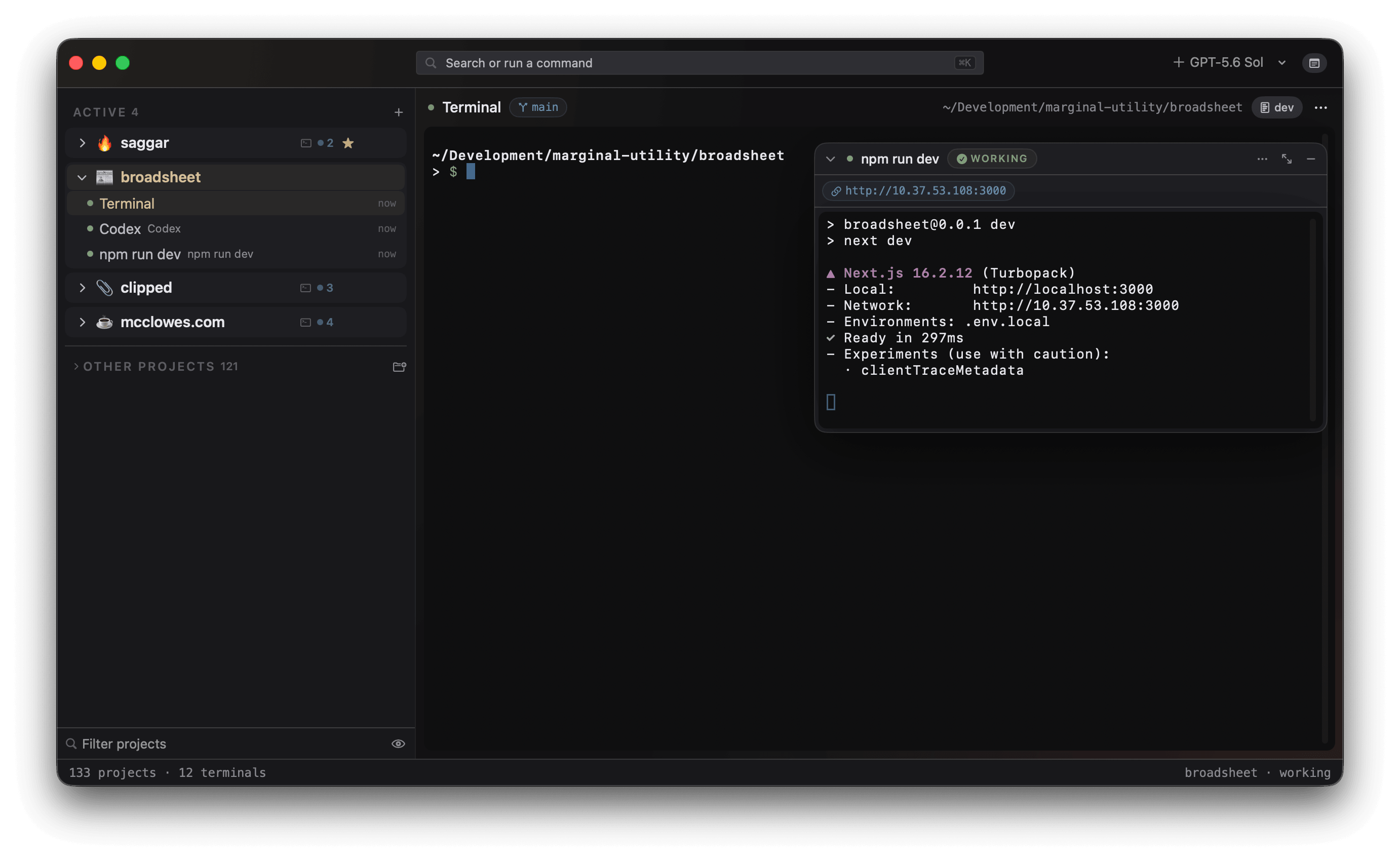
The monitor docks in the top-right corner, read-only, never taking focus. It is scoped to its project, so it follows you across that project's sessions and hides when you leave.
- A running session can be moved there without a restart (Dock as monitor).
- Selecting a monitor promotes it to the main pane so you can interrupt or restart it.
- Pressing ↵ without typing docks a bare shell: the chord has already decided you want a monitor, and the field only says what it runs.
Because the premise is that you're looking elsewhere, the dock lifts two things out of the scroll: the served URL, clickable, and the "ready in 340 ms" line that says it came up. Errors in the tail turn the frame amber with a count, and a dev server that dies rings the same cue any other failed session does.
A window of its own
Any session tears out into a separate window from the header's ellipsis. The layout is yours, and the app doesn't try to own your screen.
Beside the session
Scratchpad
⌘/ opens the project scratchpad beside the session. It is a local markdown
file at <project>/.saggar/scratchpad.md, kept out of Git so temporary notes
and handoff context stay in this checkout.
Peek at a background session
Hovering a menu row raises a peek card on the row's trailing side: the session's name, project, and status, its transcript's last lines, its branch and agent.
It is strictly for background sessions. One already on screen raises nothing, since a preview there would only cover the live shell with a staler copy of itself. The card takes no clicks, so the row underneath still opens on the first one.
Preview a link or path
Hovering a URL or a file path inside a terminal previews that instead:
- host and title for a link, with the page's Open Graph image and description filling in behind it;
- name, size, and first lines for a file;
- entries for a folder;
- an honest "not found" for a path that doesn't resolve.
One click opens it in the browser, the default app, or Finder.
Git state
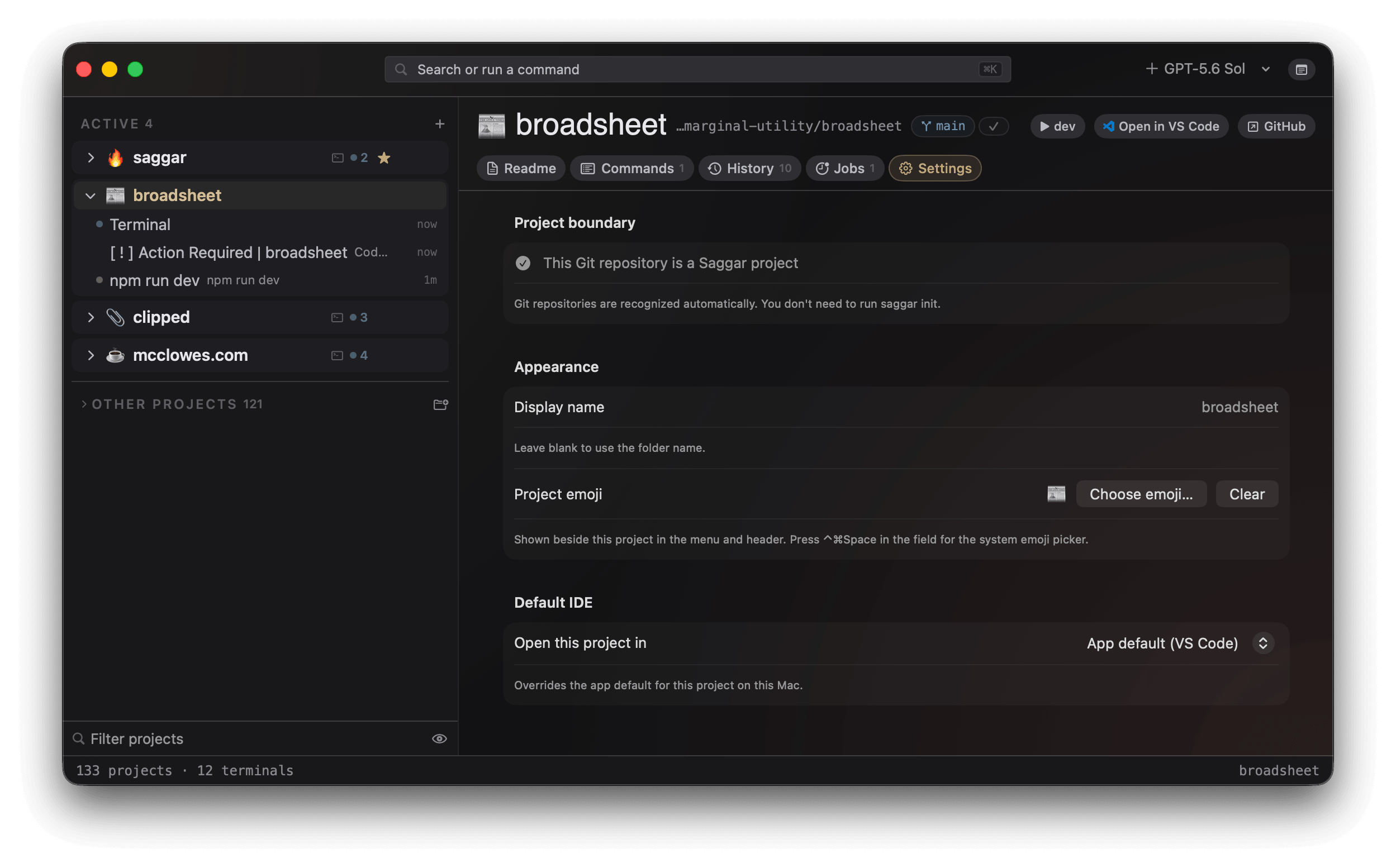
Each session, worktree, and project wears its branch alongside a state chip: how far it sits ahead of or behind its upstream, and how many files are dirty. Amber marks uncommitted work, which is also what makes "finished, but with uncommitted work" a rank of its own in triage.
Saggar refreshes after commands finish and periodically for changes made elsewhere. Untracked directories count once, and ignored files stay excluded.
Ahead and behind
Ahead and behind counts compare your checkout with Git's locally stored
upstream reference. They don't check the remote automatically. Choose
Fetch or run git fetch to update that reference.
An amber question mark, Upstream status unavailable, means Git couldn't make the comparison. If fetching doesn't resolve it, check that the branch still has a valid upstream.
Checkout-local files
Saggar writes checkout-local files into each project:
.saggar/scratchpad.md and .saggar/jobs/. When a repository's .gitignore
doesn't cover them, the project landing offers one click to append the lines.
If git already tracks a file, it says so and names the git rm --cached that
a fresh ignore rule won't do for you.
Build and run native apps
Saggar recognizes Xcode workspaces and projects, and Android projects with a
Gradle wrapper. Open the command palette and search for build, test, run,
clean, format, logs, devices, or screenshots. Finite work runs as a quick run;
Simulator and adb log streams dock as monitors.
Project settings for native apps
Project Settings can keep an Xcode scheme, build configuration, Simulator or Android device, and Android application ID. These choices stay on this Mac.
The latest task result appears beside the project and in its header. A failed result lists the source locations Saggar could parse, and choosing one opens the configured IDE at that line.
Back to session
File paths printed in terminals also open at their line number. After Saggar sends you to an IDE, Back to session returns to the live session that started the excursion.
Signing, visual layout, and deep debugger work still belong to Xcode or Android Studio. Saggar owns the build-and-attention loop around them.